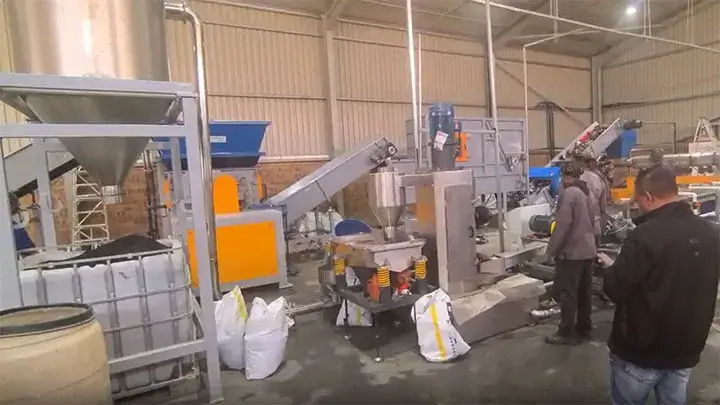
Plastic Waste Crusher Overview
The plastic waste crusher is an efficient machine for processing plastic and rubber waste. It can crush various waste materials such as profiles, pipes, films, and others into particles for direct reuse as production raw materials.
The machine uses alloy steel blades, which are wear-resistant and durable, extending the service life. The separated design makes maintenance and cleaning more convenient.
The double-layer structure is equipped with sound insulation materials, significantly reducing noise pollution. In addition, the blade shaft seat has undergone strict balance testing to ensure stable operation, safety, and reliability.
Equipped with four wheels at the bottom, the device is easy to move and adapt to different working environments. The plastic waste crusher has become the preferred equipment in the waste recycling industry due to its excellent performance and convenient operation.

I. Operating Procedures
Article 1 The driver of the crusher must be trained to achieve “three understandings” (understand the structure, understand the performance, understand the principle) and “four skills” (will use, will maintain, will upkeep, will handle faults). After passing the training examination and obtaining a certificate of competence, they are permitted to operate.
Article 2 Work closely with the working face scraper conveyor driver and the transport lane belt conveyor driver, using unified signal contact to coordinate starting and stopping.
If large pieces of coal or gangue pile up at the crusher inlet and overflow, stop the work and stop the face scraper conveyor operation. If large pieces of coal or gangue cannot enter the crusher or if metal objects are present, stop processing.
II. Preparation Work
Tools
Wrenches, pliers, screwdrivers, small hammers, shovels, etc.
Necessary Spare Parts
Various short joint chains, chain rings, bolts, nuts, crusher safety pins, etc.
Lubricants
Lubricating oil, turbine oil.
III. Inspection and Treatment
1. The coupling parts of the motor, reducer, hydraulic coupling, and head and tail of the machine must be complete, intact, and tightened. The speed reducer and hydraulic shaft joint should have no oil seepage or leakage, and the oil quantity should be appropriate.
2. The signal must be sensitive and reliable; the machine is not allowed to start without a signal. Spray sprinklers should be in good condition.
3. The power supply cable and operation line must be hung neatly, without any squeezing or damage.
4. Coal, gangue, debris near the head, and coal dust on the motor and reducer must be cleaned thoroughly.
5. The working surface scraper conveyor head and transfer machine tail lap must be appropriate.
6. The scraper chain plate tightness must be moderate; scrapers and screws must be complete and tightened.
7. The transfer machine walking trolley must operate smoothly and reliably.
8. When the transfer machine bridge section case is opened, the operation of each part should have no abnormal sound. Scrapers, chains, and connecting rings should have no twisting, distortion, or bending deformation.
9. The roadway support at the plastic grinder and crusher location must be intact and solid.
10. The plastic grinder’s safety protection net and protection devices must show no deformation or failure and must be safe and reliable.
11. The roadway support at the plastic grinder location must be intact and solid.
Get a Professional Answer for Your Needs
In order to better provide you with a professional answer, when sending an inquiry, please describe your parameters or technical requirements (such as processing materials, output size, capacity, etc.). We will reply to you as soon as possible!