Introduction: The Myth of Non-Recyclable Crosslinked PE
Crosslinked PE reclaim, whether industrial scrap or recovered post-consumer waste, doesn’t have to end up on the
scrap heap – not when a simple recycling procedure can turn it into cost-effective filler.
A paper presented at the Association of Rotational Molders meeting last October in Oak Brook, Illinois, detailed an
inexpensive way to reuse crosslinked material.
«Through a new process, we can now tell the world that crosslinked polyethylene can be recycled,» says Elmer Good,
the paper’s author and president of Gyron Compounds in Mission Hills, California.
The Recycling Process
His recycling process simply involves pulverizing the reclaimed material to the right size and then compounding it as
a filler with virgin resin. The resulting blend can then be used in rotational, injection, or blow molding.
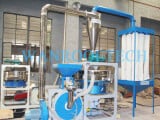
Good recommends grinding or chipping to pellet size and then pulverizing to 50–100 mesh using a PE pulverizer
machine. He estimates the cost at around 15 cents per pound.
Good has already produced a variety of rotational and injection molded parts containing 25% XLPE regrind level,
including a 30-gallon injection molded can.
Test Results: Comparable or Better Physical Properties
Recent tests conducted at Occidental Chemical Corporation’s lab in Houston have shown that parts containing
crosslinked filler exhibited comparable or better physical properties than virgin base resins.
Regrind Bonds to Virgin Material
The prevailing attitude has long been that crosslinked PE cannot be recycled. «This is all due to the fact that
crosslinked PE has a zero melt index,» explains Good.
However, he notes that heating crosslinked PE to approximately 350°F causes the surface to become tacky, allowing it
to bond to other materials. «To prove just how tacky it gets, you can spin weld a fitting onto a crosslinked PE
part, and it will actually weld to the surface,» he says.
To determine if bonding would occur between crosslinked PE and virgin material during molding, OxyChem made test
parts with 25% reclaim levels. Post-consumer bottles and milk jugs were the scrap source, with a density of 0.960
and melt indexes ranging between 0.5 and 0.8.
Before molding, the reclaim was extruded with a crosslinking agent, pulverized, and compounded with each of three
virgin HDPE resins. OxyChem then measured several physical characteristics. «It was learned that not only did the
bonding take place, but some of the physicals actually increased when 25% regrind was used,» Good reports.
Particle Size Does Matter
Similar trials with rotomolded samples additionally revealed that particle size makes a great deal of difference to
the part’s inside surface finish. Good found that reclaim ground to 35-mesh particles produced parts with a rough
finish.
Yet 100-mesh or finer particles made parts with a «much smoother» surface finish, Good says.
Other tests compared the molding behavior of reclaim-filled resin with virgin crosslinked resins. After compounding
25% post-consumer reclaim (PCR) with virgin material, the resulting blend was crosslinked using Gyron’s XL2000
process. Test parts made from the blend showed «no discernible difference over straight rotomolded crosslinked PE,»
Good says.
Commingled PCR Works Too
Another aspect of the tests showed the feasibility of using commingled, heterogeneous PCR as a filler. To each virgin
HDPE sample, Good also added commingled PE reclaim of different densities and melt indexes. He says the mix included
garbage bags, butter tubs, and bottles.
From these tests, Good concludes that even mixed PCR can be turned into a filler for rotational, injection, or blow
molding. Simply compound and crosslink the commingled reclaim and add it to a virgin base.
Get a Professional Answer for Your Needs
To better provide you with a professional solution, please describe your parameters or technical requirements (such
as processing materials, output size, capacity, etc.) when sending an inquiry. We will reply to you as soon as
possible.
This article is from the following website: thefreelibrary.com