Raw Material Types of CPP/ BOPP Plastic Film Recycling Line
- Clean CPP/ BOPP plastic film recycling line – Option A
- Moderately contaminated CPP/ BOPP plastic film recycling line – Option B
- Printed film or heavily contaminated CPP/ BOPP plastic film recycling line – Option C
| Option | Price for Option A | Price for Option B | Price for Option C |
| Budget Range | $30,000–50,000 | $45,000–70,000 | $50,000–80,000 |
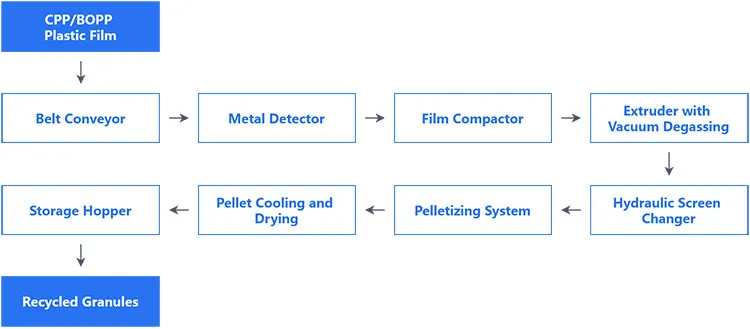
Clean CPP/BOPP Pastic Film Recycling Line
Process A: CPP/BOPP Film Waste → Belt Conveyor → Metal Detector → Film Compactor → Extruder with Vacuum Degassing → Hydraulic Screen Changer → Pelletizing System → Pellet Cooling and Drying → Storage Hopper → Recycled Granules
Suitable for: Stable raw material supply, low impurity content, no washing required, and product quality requirements compatible with single-stage systems.
Advantages: Relatively simple equipment configuration, with the potential for lower investment, footprint, and maintenance costs.
Equipment List for Clean CPP/BOPP Production Waste Film
- Belt Conveyor with Metal Detector
- Film Compactor
- Extruder with Vacuum Degassing
- Hydraulic Screen Changer
- Pelletizing System
- Pellet Cooling and Drying System
- Storage Hopper
- Packaging System
Moderately Contaminated CPP/BOPP Plastic Film Recycling Line
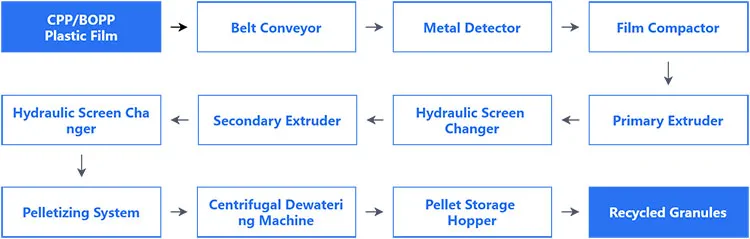
Process B: CPP/BOPP Plastic Film Waste → Belt Conveyor → Metal Detector → Film Compactor → Primary Extruder → Hydraulic Screen Changer → Secondary Extruder → Hydraulic Screen Changer → Pelletizing System → Centrifugal Dewatering Machine → Pellet Storage Hopper → Recycled Granules
Suitable for: CPP/BOPP film production plants, flexible plastic packaging manufacturers, PP film waste recycling companies, and plastic recycling plants requiring stable feeding, two-stage filtration, and continuous pelletizing.
Advantages: Stable feeding; two-stage filtration ensures low impurity levels in the final product; efficient vacuum degassing in the two-stage extrusion process; stable, continuous production; and a wider range of applications for recycled PP pellets.
Equipment List for Moderately Contaminated CPP/BOPP Film
- Belt Conveyor with Metal Detector
- Film Compactor
- Primary Extruder
- Hydraulic Screen Changer
- Secondary Extruder
- Pelletizing System
- Centrifugal Dewatering Machine
- Pellet Storage Hopper
Printed Films or Highly Contaminated CPP/BOPP Plastic Film Recycling Line
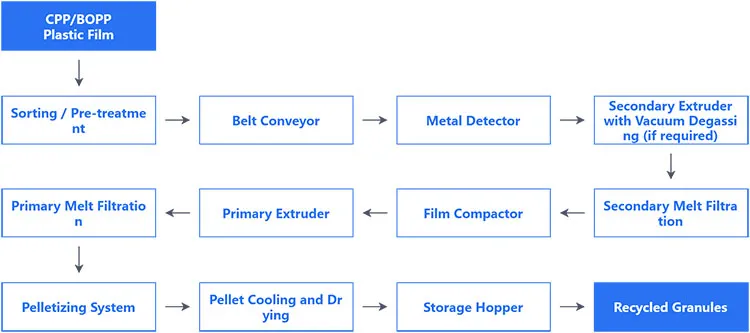
Process C: CPP/BOPP Film Waste → Sorting / Pre-treatment (if required) → Belt Conveyor → Metal Detector → Film Compactor → Primary Extruder → Primary Melt Filtration → Secondary Extruder with Vacuum Degassing (if required) → Secondary Melt Filtration → Pelletizing System → Pellet Cooling and Drying → Storage Hopper → Recycled Granules
Suitable for: Raw materials with high contamination levels that require more precise control over melt filtration, degassing, and pellet quality.
Advantages: More flexible process configuration, allowing for tailored filtration and degassing based on varying impurity loads.
Equipment List for Printed Films or Highly Contaminated CPP/BOPP Films
- Sorting Conveyor / Sorting Station
- Pre-treatment Equipment
- Belt Conveyor
- Metal Detector
- Film Compactor
- Primary Extruder
- Primary Melt Filtration System
- Secondary Extruder with Vacuum Degassing
- Secondary Melt Filtration System
- Pelletizing System
- Pellet Cooling and Drying System
- Storage Hopper
- Packaging System
Key Considerations for Selecting a Plastic Film Recycling
Basic Selection Factors: Raw material type, target production capacity, intended use of recycled pellets, project budget
| Target Production Capacity for the Entire Line | CPP/BOPP Raw Material Types | Applications of Recycled Pellets | Equipment Configuration and Positioning |
| 100–200 kg/h | Clean production scrap | Standard Recycled PP Pellets | Economy |
| 200–300 kg/h | Printed packaging film | High-Quality Recycled PP Pellets | Standard Export Configuration |
| 300–500 kg/h | Post-consumer waste packaging film | Modified or Injection-Molding Grade Pellets | High-Automation Configuration |
| 500–800 kg/h | Mixed or laminated packaging film | ||
| 800–1,000 kg/h |
Does CPP/BOPP film require washing?
Not necessarily. Clean production trimmings, clean printed film, or industrial waste film with a clearly identified composition can be directly compacted and extruded. Material containing food residues, grease, silt, or other contaminants requires sorting, washing, and drying. For PP/PE, PP/PET, or aluminum-foil-laminated films, standard filtration and two-stage extrusion cannot thoroughly separate the different polymers; separate pretreatment is required.
Are Two Hydraulic Screen Changers Necessary?
If the raw material is clean and contains few impurities, they are not necessary.
Is Two-Stage Extrusion Always Better Than Single-Stage Extrusion?
The choice between single-stage and two-stage extrusion should be based on a comprehensive evaluation that considers the level of raw material contamination and target production capacity, compares the total costs of single-stage vented extrusion, single-stage forced filtration, and two-stage extrusion, assesses the actual benefits of two-stage extrusion and two-stage filtration, and takes operating costs into account.
Selecting a Pelletizing System
| Types of Granulation Systems | Applications |
| Water-Ring Pelletizing | General-purpose film recycling and pelletizing |
| Strand Pelletizing | Low investment, clean and stable raw materials |
| Underwater Pelletizing | High production capacity or high pellet consistency requirements |
| Air-Cooled Die-Face Pelletizing | Applications with water restrictions |
Related Equipment
-

Used Chemical Fiber Agglomerator Machine For Sale
-

Plastic Waste Extrusion Pelletizing Machine PE Granulating Machine
-

Juice Box Paper Separation Milk Carton Recycling Machine
-

Paper Pulp Making Belt Press Filter for Sludge Treatment